
Internal Side of Public Affairs – 74 Your AI is only as good as your data. So where is yours?
By Alan Hardacre, PhD
Co-Founder Advocacy Academy, Advocacy Strategy
Most Public Affairs functions have a data problem. They just don't know it yet — because the tools have been hiding it.
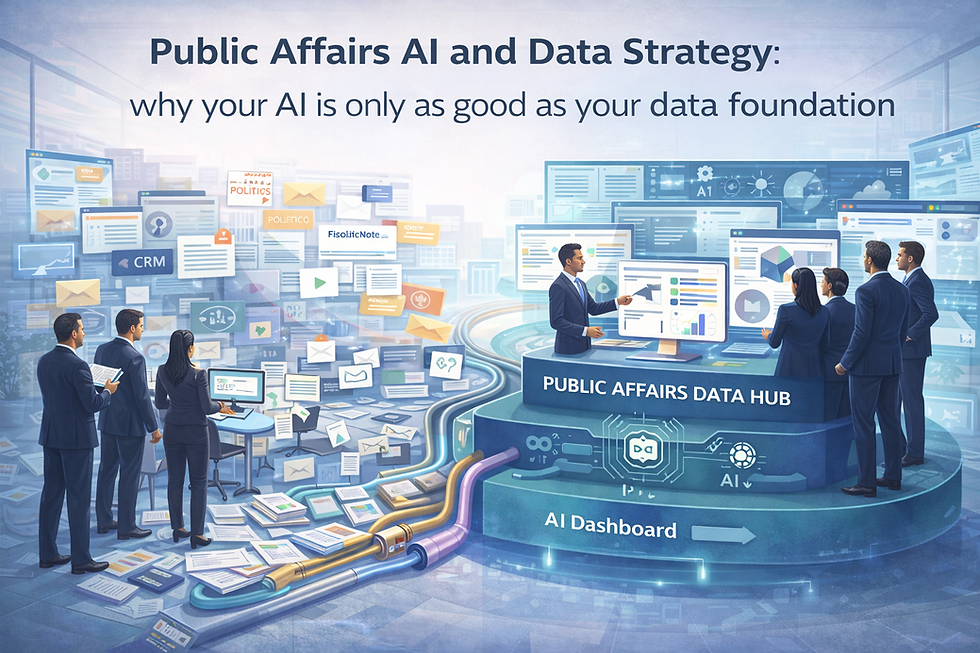
Most Public Affairs and Government Relations teams do not have a data strategy. They have subscriptions. They have a monitoring platform, a CRM of sorts, a shared drive full of documents, and a collection of consultant reports landing in inboxes. Each of these contains genuinely valuable intelligence. But it lives in separate places, in formats chosen by suppliers, triggered by supplier logic, and structured around supplier workflows. Often it lives in the supplier platform itself. The team then sees what the different platforms show them — not what their business actually needs to know. I am seeing this more and more as I talk to Public Affairs professionals in-house, in Trade Associations and in consultancy.
Let me be clear - data has always been a source of frustration in the profession. But it matters now more than it ever has. Because the value of AI in Public Affairs is not in the tools themselves. It is in what those tools can do when they are applied to data that is yours — structured around your issues, your markets, your stakeholders, your risk thresholds. Generic AI applied to generic data produces generic output. That is not a competitive advantage. It is a productivity tool at best. And we are now genuinely in a place where we can do so much more — but only if the data foundation is there. And at the moment it is a critical hygiene factor that the profession needs to work out how to solve.
Painful process – but worth it
The teams pulling ahead are not necessarily using more sophisticated AI. They are doing something more fundamental: they are managing and organizing their data and then treating their external platforms as data sources rather than end-to-end solutions. And then they are building their own AI layer on top – in a very tailored way.
This does not mean replacing your monitoring platforms or your consultants or walking away from the tools that work. FiscalNote, Quorum, Politico Pro, DeHavilland — these are excellent at aggregating and processing vast amounts of data. They monitor and add intelligence that is genuinely hard to replicate. The point is not to rebuild what these services do well. It is piping that data into your own structured environment, where your team's AI and automation logic can act on it.
When you do this, something important changes. You can cross-reference legislative signals with your own operational data. You can generate briefings in the formats and cadences your internal stakeholders actually need. You can apply your organisation's specific context — your business units, your product lines, your history with a regulator — to interpret what a policy development actually means. That is where proprietary value is created. And it is value that survives any supplier change, price increase, or platform pivot. Your data structure and management is becoming a real advantage – but it is not an easy change to make, and it cannot be made alone.
What this looks like in practice
For most large in-house teams, the building blocks are already there. Whether your organisation runs on Microsoft 365, Google Workspace, or a Salesforce ecosystem, the infrastructure to pull external data into your own environment, apply your own AI logic, and automate how intelligence reaches internal stakeholders already exists. The question is not whether the technology is available. It is whether anyone in the Public Affairs function has mapped the problem clearly enough to make use of it.
One team I worked with recently discovered that the same intelligence was arriving through three separate platforms, being manually summarized by different people, and reaching the business in different formats with different conclusions — sometimes in the same week. And here the services were good and the tools were not broken. It is just there was not central data management.
The reason most teams haven't made this move isn't technical capability or budget. It's that the data question has never been clearly owned and it is, like much of what we discuss with AI more of a transformation process. It means changing the way we work – by storing, sharing and processing information in a very central and structured way. Public Affairs teas need to really understand their data workflow and be able to articulate the data management architecture required to give them a platform for AI. And then the transformation begins – setting course and being sure to bring everyone with you.
From recent conversations this issue will be familiar to many of you who are looking at where your Public Affairs team is on your data maturity journey. You only need to look at other functions in your organisation – and you realize that the functions that learn to own and leverage their data are more likely to be seen as strategic assets. Public Affairs has struggles with this for many years – but now has a real opportunity to close this gap.
So where to start
Hygiene factors. A Public Affairs AI policy. A data management structure and process. And then identifying the main use-cases you want to start with – and all of this before evaluating any new tools or redesigning any workflows. In many ways the most useful starting point is an AI audit that will look at what data you have and what data is coming in and from where. It will also look at how you manage the structure the data – and any organisational policies you have governing data and AI. From there you will audit what people are currently doing (tools and use-cases) and what they would like to do in the future. This will give you a great snapshot of where you are and where you want to be – and hence able to plan to bridge the gaps you inevitably will find.
Looking at Public Affairs teams who have embarked on this journey there is one key thing they all discover. They all have more data and opportunity than they realized. And there are many potential use cases for how AI and automation can support them from there. The AI tools are ready. The platforms are capable. What most Public Affairs functions are missing is the data foundation that makes all of it work properly.
If this is a live challenge for your team, get in touch.


Comments