
The Expanding Mandate: Scope Creep in Public Affairs - Internal Side of Public Affairs 71
By Alan Hardacre, PhD
Co-Founder Advocacy Academy, Advocacy Strategy
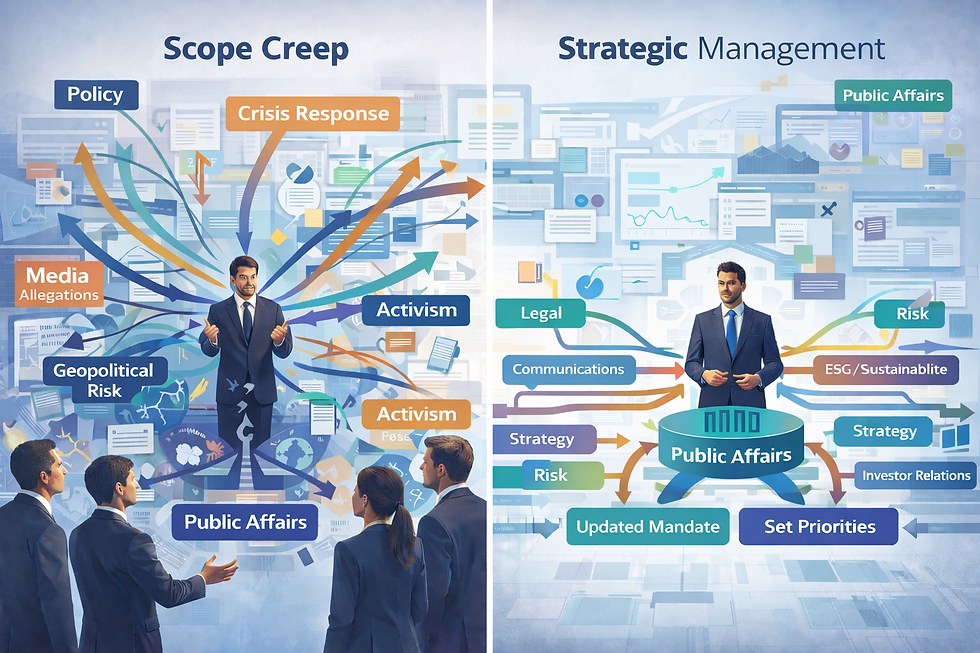
Public Affairs has always sat at the intersection of politics, regulation, reputation and commercial strategy. But in today’s environment — characterized by so much (geo)political instability, regulatory acceleration, uncertainty, activism, disinformation and real-time media dynamics — that intersection is widening. And, as external complexity increases, so too does internal demand. I know no two Public Affairs team do the same thing – they all have their own scope – but each in their own way it seems like many teams are under scope creep pressure into new areas. Conversations with Public Affairs leaders tells me that all of them are facing an expanding list. It seems to me that for Public Affairs professionals, this is one of the defining operational challenges of the moment.
Why Scope Creep Is Accelerating Now
Scope creep is not new and is felt differently in all Public Affairs teams but three structural dynamics are intensifying it:
1. The External Environment Is More Politicized
Issues once considered operational or commercial are now political. Supply chains, data flows, decarbonization, AI, DEI, pricing, infrastructure — all carry policy implications. Public Affairs is therefore pulled earlier and into more conversations.
2. Internal Demand for Political Interpretation Has Increased
Boards and executives want forward-looking insight. They want to understand regulatory trajectory, election outcomes, geopolitical exposure and stakeholder risk. Public Affairs becomes the in-house interpreter of uncertainty.
3. Organisational Boundaries Are Blurring
Public Affairs already often overlaps with Legal, Communications, ESG, Sustainability, Strategy, Risk, Investor Relations and others. In these changing times, the lines between these functions soften — and Public Affairs is often expected to fill the gaps and/or it creates significant internal friction and uncertainty as to who is responsible.
The result of all this is very predictable: expanded expectations without expanded mandates or resources – and all without clear internal governance.
The Challenges of Scope Creep
When unmanaged, scope creep creates structural strain. I see four recurring patterns.
1. Pulled in All Directions
Public Affairs becomes the organisational catch-all for anything political. Urgent requests dominate. Time horizons shorten. Teams move from strategic prioritization to constant responsiveness. The risk is not just workload — it is dilution. When everything is priority, nothing truly is – something I discuss often.
2. Resource Drain Without Strategic Trade-Offs
Additional responsibilities rarely come with proportional investment – and certainly not at the start. Policy monitoring expands. Stakeholder engagement increases. Internal briefings multiply. Crisis preparedness becomes continuous. Without explicit choices about what stops, Public Affairs capacity is quietly eroded. This creates fatigue and reduces strategic depth.
3. Loss of Focus on Core Objectives
Public Affairs is most effective when it operates with:
Clear commercially aligned policy priorities
Defined engagement strategies
Long-term relationship investment
Measured objectives
Scope creep fragments that focus. Time for proactive influence shrinks as reactive advisory work grows. Relationship-building — the foundation of long-term impact — becomes episodic at best.
4. Accountability Becomes Blurred
As the mandate expands informally, metrics lag behind. Public Affairs may be delivering across a widening spectrum — but without a re-articulated mandate, expectations become implicit and success harder to define. Over time, this creates reputational risk internally. The team is busy — but perceived value may not scale with effort.
At the same time scope creep offers some real strategic opportunities.
The Strategic Opportunity Within Scope Creep
Scope creep is not only a threat. Handled deliberately, it can be an internal upgrade moment. When Public Affairs is drawn into more conversations, it often reflects recognition that policy and politics are central to commercial strategy. The opportunity lies in converting informal expansion into intentional growth. Here are four ways that Public Affairs leaders are making this happen.
1. Increased Internal Visibility
Greater involvement in cross-functional discussions elevates Public Affairs’ internal profile. Board exposure increases. Strategy teams seek input earlier. Commercial colleagues recognize policy as a growth lever — not simply a risk factor. Visibility, if managed well, strengthens influence.
2. Broader Strategic Mandate
Scope expansion can provide the basis for a formal redefinition of remit. Instead of resisting new responsibilities outright, Public Affairs leaders are asking:
What does this tell us about how the organisation sees political risk and opportunity?
Should our mandate evolve to reflect that reality?
What structure and resource would be required to do this well?
In other words, scope creep can become scope strategy.
3. Stronger Integration into Commercial Planning
When Public Affairs is pulled into market entry, product strategy, or supply chain resilience discussions, it signals maturity. Policy insight becomes embedded into commercial decision-making — not appended to it. This strengthens Public Affairs’ role as strategic infrastructure rather than specialist advisor.
4. Platform for Long-Term Growth
Handled effectively, expanded expectations can justify:
Additional headcount
Clearer reporting lines
Formalized integration into planning processes
Enhanced Board engagement
Public Affairs led projects and internal alignment groups
Investment in Public Affairs capability
But this only happens if expansion is made visible and measurable.
Managing Scope Creep Deliberately
The challenge, therefore, is not to prevent expansion — that is unrealistic in the current environment. The challenge is to manage it consciously. A few practical reflections:
Clarify Priorities Quarterly
In volatile environments, annual plans quickly age. Revisit and restate policy priorities regularly.
Define What Stops
When new responsibilities emerge, articulate what will be deprioritized. Silent trade-offs erode quality.
Track Demand
Document incoming requests and time allocation. Data transforms anecdote into case for resource.
Rearticulate Mandate Annually
Ensure the formal description of Public Affairs reflects the reality of what it is being asked to do. Annual leadership surveys are a great way to do this.
Protect Strategic Time
Reserve capacity for proactive engagement. Without this, Public Affairs becomes purely reactive — and loses its differentiating value.
Scope creep is currently a sign that politics and policy are moving closer to the center of corporate commercial decision-making. The real risk is not expansion - it is expansion without intention. In today’s dynamic external environment, Public Affairs professionals are uniquely positioned. They understand regulatory direction, stakeholder expectations, geopolitical risk and reputational exposure. As organisations seek certainty in uncertainty, the demand for that insight will continue to grow.
The question is not whether the scope will expand. It is whether Public Affairs leaders will shape that expansion — or simply absorb it. The difference lies in clarity, prioritization and leadership.


Comments