
Beyond Access: Turning Political Capital into Strategic Advantage
- Oct 9, 2025
- 5 min read
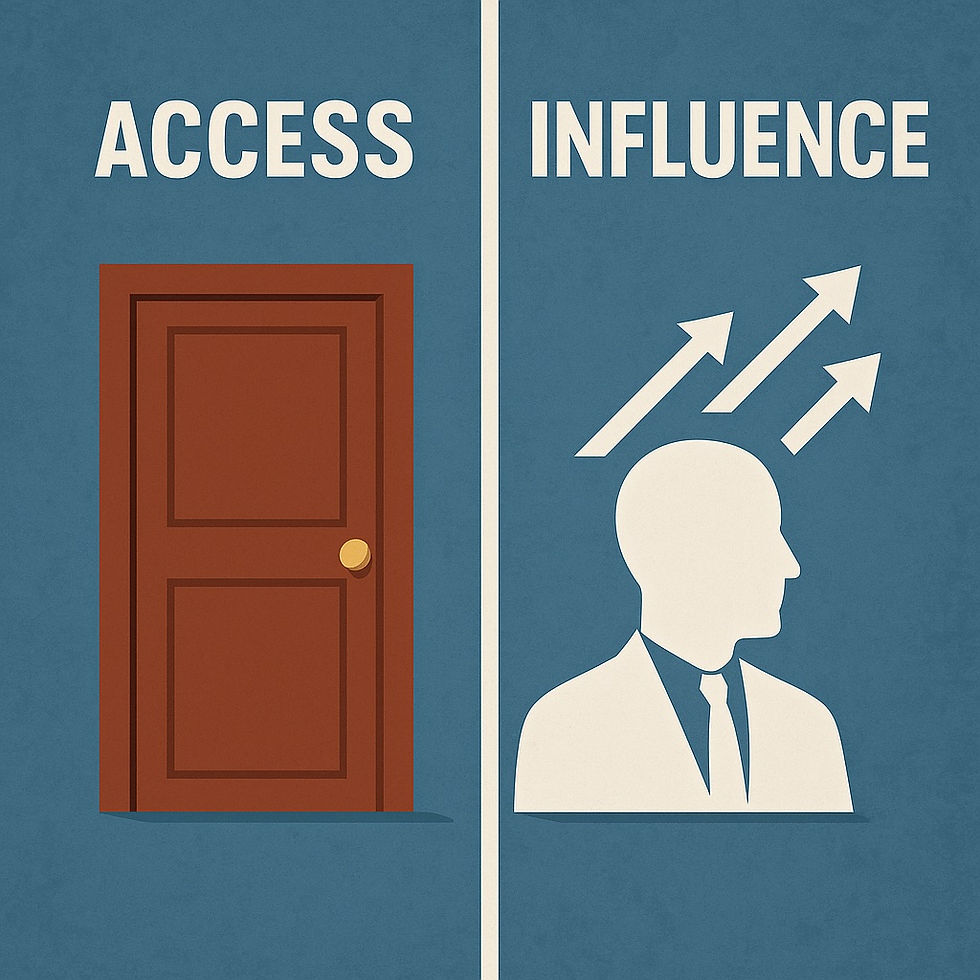
In Brussels, Washington, and every other capital where policy meets profit, “access” still holds mythical appeal. Entire agencies sell it. Executives boast of meetings with ministers, speaking slots at conferences, and photos beside EU Commissioners.
It looks like influence. It feels like influence.But it rarely is.
Access alone is not power. It’s often an elegant way to waste it. The question every executive should ask is simple: Does this access translate into outcomes that move the business forward?
The companies that genuinely shape their regulatory environment don’t pay for proximity. They convert political capital into strategic capital - integrating insights from the political arena into business models, market positioning, and investment timing.
According to McKinsey, up to 30% of corporate earnings in highly regulated sectors can be affected by government action. Yet few organizations treat political dynamics with the same analytical discipline they apply to market trends or capital allocation.
Those who do outperform - not because they meet more politicians, but because they use what they learn to act sooner, smarter, and more decisively.
The Access Illusion
Access offers comfort. It creates the illusion of control - of being informed, “in the loop,” close to decision-makers. And sometimes, it works: an issue raised in the right room at the right time may genuinely shift policy.
But those moments are exceptions, not a strategy. Information without integration is just noise.
Many organizations maintain impressive networks of policymakers, associations, and consultants - and still get blindsided by new regulation. The problem isn’t a lack of data; it’s the failure to connect that data to core business decisions.
Academic research has long shown that politically connected firms outperform peers only when connections are operationalized. When they aren’t, “access” becomes an expensive ritual - a corporate placebo that produces the sensation of relevance without measurable results.
In that sense, access is like oxygen: necessary to breathe, but useless without movement.
Timing and Readiness
Political influence is nothing static. It is dynamic, time-sensitive, and highly contingent. John Kingdon’s “multiple streams” framework still offers the best way to understand this. Policy change happens when three currents - problems, solutions, and politics - briefly converge.
When they do, a small window opens.
Only those prepared can push something meaningful through it.
For business, the lesson is clear: influence equals timing multiplied by readiness. The best Public Affairs teams don’t just monitor legislation; they monitor alignment. They map when public sentiment, institutional appetite, and technical feasibility are likely to intersect - and they ensure that when that moment arrives, their proposals are already on the table.
Those who arrive late find that the rules are already written - and rarely in their favour.
From Speeches to Spreadsheets
Influence becomes real only when it changes behavior inside the firm. A serious Public Affairs function does not speak the language of speeches; it speaks the language of spreadsheets. Every regulation, amendment, or committee vote should be framed in terms a CFO understands: costs, margins, competitiveness.
“If Article 8 passes, our cost per unit rises by four percent. If Article 9 prevails, our competitors gain a two-year head start.” Such sentences align organizations far faster than pages of policy analysis. Translation is not decoration; it is the bridge between political intelligence and business action.
Without that translation, Public Affairs risks confirming its worst stereotype - the department that produces elegant memos about battles already lost.
Influence as Capital
Political capital behaves like financial capital. It can be built, invested, or squandered - but never assumed to be infinite. Every meeting, every statement, every ask consumes (and sometimes creates) a small portion of it.
The most effective companies manage influence like an investment portfolio:
They engage only when the stakes are high, the evidence strong, and the timing right.
They prioritize building credibility before spending it.
They recognize that silence, too, can be strategic.
The art lies in restraint. Not every legislative initiative deserves a campaign. Not every policymaker needs activation. And every engagement should answer one question: What value are we offering the decision-maker in return for their attention?
When influence is used sparingly and purposefully, it compounds - in trust, in real influence and in impact. Overuse, by contrast, devalues the currency. A company that comments on everything soon becomes background noise, the corporate equivalent of someone who shouts “urgent” in every email.
Integration, Not Decoration
The structural problem in most organizations is not that Public Affairs is ineffective - it’s that it’s misplaced. Too often, it sits downstream, between communications, legal, and compliance. It’s invited to celebrate victories or explain defeats, but rarely to design the plan.
That’s a costly oversight.
Policy foresight belongs upstream, in the same strategic discussions where R&D budgets are set, markets chosen, and sustainability roadmaps defined. Every major investment today carries regulatory risk. In Europe, a single legislative cycle can determine the viability of entire product lines.
Treating Public Affairs as a late-stage reviewer is like asking the fire inspector to check your alarm system after the roof is burning brightly.
Integrating policy foresight into corporate strategy doesn’t just prevent risk - it can unlock opportunity. When regulatory insight informs product development or market timing, it can tilt competition decisively in a company’s favor.
Measuring What Matters
What gets measured defines what gets valued. Yet most Public Affairs dashboards still feature theatre metrics: the number of meetings, events, or press mentions. These figures impress no one accustomed to running a P&L.
Influence should be measured like any strategic function - through outcomes. Which regulatory risks were mitigated early? Which strategic pivots were informed by policy foresight? Which new opportunities were captured before competitors noticed?
If your Public Affairs metrics cannot answer these questions, they may be measuring motion, not progress.
Earning Internal Legitimacy
Paradoxically, the hardest part of turning political capital into business advantage isn’t managing policymakers - it’s convincing colleagues.
Inside many corporations, Public Affairs is still seen as a soft discipline, useful for messaging but irrelevant to the bottom line. That perception won’t change through more internal reports. It changes through tangible results.
When early action prevents a costly policy setback, quantify it and communicate it. When foresight avoids a misaligned investment, make sure the CFO sees the savings. Influence becomes legitimate only when it earns its way onto the balance sheet. This shift also demands a mindset change within Public Affairs itself: from informers to integrators, from storytellers to strategists.
The most respected PA leaders are not those with the most contacts, but those who can translate the regulatory environment into financial logic and business foresight.
The CEO’s Role
Executives play a decisive role in this evolution. They must treat Public Affairs as a strategic intelligence system, not a courtesy function.
One question reveals whether that system is working:
“Which upcoming policy decisions could materially alter our business model - and what are we doing about them now?”
If your Public Affairs lead can answer immediately, you are ahead of the curve. If not, your company is flying on political autopilot - a dangerous mode in an era when regulation often moves faster than innovation.
A Final Thought
Access can be bought. Influence is earned. Influence is not about being heard, but about being understood - and acted upon. It’s not about collecting information, but about converting insight into foresight. It’s not about the photo opportunity, but about shaping the conditions under which the next photo will be taken.
Political capital is a perishable asset. Left idle, it fades quietly. Invested wisely, it compounds - not in headlines, but in resilience, competitiveness, and the rare satisfaction of knowing your company didn’t just adapt to policy. It helped write it.


Comments